|
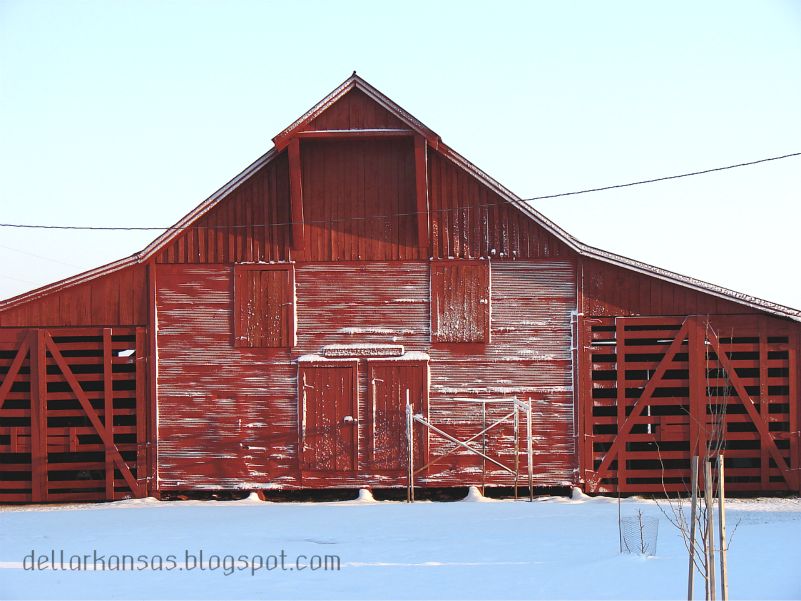
| EARL MAGERS BARN, built ca 1930 at the Widner-Magers Farm Historic District |
History of the Widner-Magers Farm Historic District,
Earl Magers and Dell
Constructed
between 1912-1939, the Widner- Magers Farm Historic District is comprised of
five buildings and three outbuildings. Located on North Arkansas State
Highway 181 approximately 1.6 miles north of Dell, Mississippi County,
Arkansas, the complex is being nominated to the National Register of
Historic Places with local significance for its association with cotton
farming in Dell and Mississippi County, Arkansas. Set against a backdrop
of cotton fields and the Pemiscot Bayou, the WMFHD has been a center of agricultural activity since
1896, however, most of the buildings were constructed by Earl Magers
between 1930-1939. Excellent examples of 20th century Plain/Traditional and
Craftsman architectural-style, the farm buildings have been maintained
with few changes by the Earl Magers/Curtis Duncan family for 77 years.
The Widner-Magers Farm Historic
District is located on Arkansas North State Highway 181 in the northern
part of the Mississippi County, Arkansas Delta, 9 miles west of
Blytheville, Arkansas, and 10 miles south of the Missouri Bootheel. It is north of the present town of Dell, in the township of
Hector.

The original absentee owner
of the future Magers property was Thomas J. Blackmore, who acquired
159.17 acres on June 17, 1855, through the Swamp Land Act of 1850.
This property would pass through several more absentee owners until
1878 when W. B. Sizemore, one of the original pioneers of the area,
bought it. He owned the land until his death, when his son Robert
Sizemore inherited it. J. D. Widner apparently bought the land
sometime around 1896. In an affidavit of March 1926, Hugh and J. W.
Perry stated that J. D. Widner had lived and farmed the acreage for
thirty years.
Between 1878 and 1902, the
Dell community was located north and west of the Pemiscot Bayou. The
settlement had a population of approximately two hundred people. Mr.
Widner and his family were a part of this settlement. Neighbors
included the Hector families, who were the first settlers east of Big
Lake. They moved to the area in 1832. The township is named after
them. Other neighbors included the Perrys, the Sizemores, the
Petersons, the Rays, the Daughterys, and others. Many of the original
families were of Cherokee descent, including the Hectors. Their houses
were built on the many Indian mounds along the Pemiscot Bayou, for the
area was very swampy and subject to flooding each year. A number of
the early settlers are buried on one of the old cemetery mounds
approximately 1/2 mile south of the Widner homestead. Descendents of
these early families still live in the area. In fact, a descendant of
Sam Hector lived on the Magers farm until his death in 1995.
The community depended on the
Pemiscot Bayou as access in and out of the area. There were no roads,
only trails. The swampland was flooded much of the year, which made
ground travel almost impossible. The Dell community was on somewhat
higher ground. A post office has been reported to have been there
since 1889, but the postal service records states the first post
office was in 1897, located in J. B. Richardson’s store, on the
south side of the bayou. Mr. Richardson also owned a loading dock
there, where goods could be brought in and cotton, wood, furs, fish,
and game could be sent south to the Mississippi River or north to St.
Louis, Missouri. A wooden bridge crossed the Pemiscot Bayou at
Richardson’s store. In 1896, School District #23 was formed. The
first schoolhouse was built not too far south from Mr. Widner’s farm. The
building was also used as a community church.
In 1902, big news arrived at
the Dell community. The railroad was coming! The Jonesboro, Lake City,
and Eastern Railroad was building a bridge across Big Lake, just west
of Dell, in order to access the thousands of acres of virgin
timber. Dell was a boomtown
overnight. Farmers from all over the country moved in behind the
massive logging industry, buying the cutover land for as little as
fifty cents per acre. Some of the original farmsteads north of Dell
began to be divided into small farm lots. Mr. Widner apparently sold
part of his acreage in this fashion, but he kept the best land and his
farmstead for himself until 1930.
Earl Magers was one of the
many farmers who came to Arkansas to buy the cheap, rich, swampland.
He arrived with his wife and two daughters in 1916. The year before,
the family had moved from their home in Hayward, Missouri to Yarbro,
Arkansas. Earl was not impressed with the land there. He made a trip
further south to the Dell area, only to find richer soil, plus the
opportunity to fund his farm through real estate transactions. He
returned to Yarbro to gather his family.
Earl was a major influence in
the shaping of Dell and it’s communities. From 1916 until 1957, when
he died, Earl remained in Dell. He bought and sold many parcels of
land, including lots in and outside of Dell. He was not a real estate
agent. His interest was in helping the community grow. In 1919, he
bought the remainder of the First Addition of Dell owned by the Sparks
Brothers Land Company, Inc. He kept an entire block of lots for his
own home and for the future homes of his three daughters. He sold the
remainder lots to other families. He also built many of the early
houses in Dell, with the help of local labor. He set aside one section
of the First Addition of Dell for the black community. There he had
several of the houses and establishments built. One of those
buildings, the grocery, is now located at the Earl Magers Farm
Headquarters.
 |
| MAGERS BARN, built ca 1930 |
In 1918, Earl served as
recorder for the Dell town council. From 1925-29, he was mayor of that
same council. From July through October 1928, he was postmaster for
Dell. During the 1920’s, he took his turn with others as town
marshal. That was the days of walking the levee to make sure no one
dynamited the long mounds of dirt in order to relieve the water
pressure up north but causing flooding south. He also rounded up many
stills, holding raids on "moonshiners" during the Prohibition.
One of the major
accomplishments of Mr. Magers occurred during the Great Depression,
when most school systems operated in the red and many had to close.
With only an eighth grade education, Earl, and the school’s
principal, Mr. Mullins, kept the Dell School in the black for all but
one year. He served on the Dell School Board from 1933-1941 and was
instrumental in consolidating Half Moon, Ekron and Perry schools into
the Dell School District. Until 1939, the Dell School only had eight
grades. Students had to travel ten miles to Blytheville in order to
finish high school. Mr. Magers worked hard to turn the Dell School
into a twelve grade system. In 1939, Dell had its first graduating
class.
Earl Magers also served on
the Dell Methodist Church Board of Directors for many years. When the
church leaders decided they needed a new facility, Earl was appointed
to the building committee. The new church was dedicated in 1950. There
was no mortgage on it. All debts were paid in full. The new church
appeared in Life magazine.

Three cotton gin companies
were built in Mississippi County due, in part, to Earl Magers’
efforts. The State of Arkansas incorporated the Dell Gin Company,
which was located inside the Dell City limits, on June 5, 1926. Earl
was one of the first stockholders, along with C. F. Floyd, J. N.
Welborn, Charles Armstrong, E. M. Woodard, J. L. Wallis, S. T.
Freeman, and E. A. Stacy. He was elected secretary and appointed,
along with Charles Armstrong, to "look after the building of the
gin and purchase material". The Dell Gin Company ran until 1975,
when liquidation of the assets began.
On May 20, 1946, the State of
Arkansas incorporated the Farmer’s Gin Company of Dell. Earl Magers,
Ulric Moore, Leslie Moore, Russell Greenway, and Dewey Sheppard were
the principle stockholders. The ginning facilities were located
approximately one mile from Dell, on east Highway 18. The Farmer’s
Gin Company was in operation until 1985.
The third cotton gin Earl
helped established was built at Half Moon, Arkansas. This structure
was entirely composed of poured concrete. Because of the threat of
fire, most cotton gins in the area were framed in wood, but the walls
and roof were covered in tin. This concrete building was an experiment
in the gin building concept.
Earl was interested in
developing the farming industry in Mississippi County by using
innovative ideas. One example was his foresight in the use of an
irrigation system during hot, dry summers. In 1951, he was the first
farmer in this area to build and use such a system. Area farmers were
invited to witness the event, which was well attended. Most farmers
today still use irrigation.
Another innovative practice
Earl began was to clean, weigh, and bag a part of the soybean crop as
it was harvested in the field. Enough of the bagged soybeans were kept
for the next year’s planting. The excess bags were sold to other
area farmers at a reduced rate, bringing down the cost of buying seed
each year.
 |
| WIDNER-MAGERS FARM HISTORIC DISTRICT LOGO |
For himself and his family,
Earl was interested in obtaining the best farmland in the area. On
March 5, 1930, Earl bought the 50.51-acre farmstead from J. W. Widner
and his wife Kittie. He paid $6566.30 for it ($4566.00 cash to the
Widners and took over a $2000.00 note). He already owned a number of
acres in the Dell area, but this property was centrally located and an
excellent choice for a headquarters. Also, there were several houses,
barns and outbuildings that could be incorporated into the complex.
Earl moved the original Widner home to a new location for one of his
farmhands and built a new house for his farm manager. This is the
present house found at the headquarters. Within the 50.51 acres Earl
bought, more farmhouses were built for the ten to fifteen families who
worked for him. A 1938 map indicates at least twelve houses lined
either side of the road on the Magers property, close to the complex.
Two large barns were also built within a mile from each other to house
the livestock, hay, and equipment used for farming. The barn, still
standing at the farm complex, housed the mules, a few horses, and some
of the wagons. The cribs in that barn held corn and feed for the
stock. It also stored cottonseed each year. One of the old wagons and
a few pieces of the original equipment are still housed in this barn.
The small barn shed, built by Mr. Widner and located at the
headquarters, was also used for animal stock.

The largest barn, less than a
mile away and located on the Pemiscot Bayou, stored hay and was
shelter for the cows and horses. A shed for the pigs was close-by.
Both of these buildings were torn down years ago.
All barns, farmhand houses,
outbuildings, and sheds were painted red with white trim, Earl’s
trademark. Cypress was the wood of choice, for it was very abundant in
the area. Lumbering was still a big business until the late 1930s.
Much of the lumber used on the Magers farm was virgin timber, cut and
milled close-by. It was plentiful, cheap, and a natural deterrent of
termites and other insects. The barns and buildings were built to
last. Unfortunately, when farming turned to mechanization and tractors
replaced mules, the sheds of the old barns weren’t wide enough to
house the tractors and their equipment, which is one of the main
reasons some beautiful old barns were torn down. The large barn and
the smaller barn shed at the headquarters are the only ones left on
the original Magers acreage.
In 1957, Earl Magers died of
cancer, as was the fate of many of the early farmers. I was ten days
from being six years old. My Mom, Irene Magers Duncan, inherited part
of the 1000+ acres and the 1.34-acre farm headquarters. She and my
Dad, Curtis Duncan, had moved to Dell in 1950. He worked for Earl as
the Farmers Gin manager and "right hand man". After Earl’s
death, Irene’s inheritance became the C. C. Duncan Farm. My father
ran the farm, while maintaining his position at the Farmer’s Gin
Company. In 1975, he retired from farming. The Dilldine Farms of Half
Moon, Arkansas began renting the land for crop rent and continues to
do so today.
For the next thirty years,
the farm complex was used very little, mainly for the storage of
cast-off farm equipment and a multitude of old tires. Only Mr.
Dilldine’s farmhands occupied the farmhouse. For the most part,
these barns and buildings, with all the rich history within their
walls, laid in wait. The complex waited and watched as one by one the
other farmhouses, barns, and outbuildings disappeared from the area.
Its only inhabitants were barn owls, rabbits, mice, and snakes.
In December 2004, Irene
Magers Duncan passed away suddenly. Granddaddy had left the farm to
the "heirs of her body", being my brother Richard and me.
Preserving a little of the Delta farm history by returning the farm to
the 1930’s had been a dream of mine for many years. Some trading
took place. The farm complex became mine
My Dad was able to see the
beginnings of the dream coming true before he passed away in 2005. I
spent long hours with him, pouring over old photographs and listening
to his stories. He gave me much information about the farm, the
people, and the land. He was able to make one last visit to the
headquarters in 2005, just to make sure that we "got it
right". His final comment was, "It’s good to see Life come
back into this ole farm. Now, I know it will be taken care of."
I see the Magers Farm
Headquarters as an opportunity to preserve a part of the disappearing
Delta history. It’s an opportunity for visitors to observe a farm
complex of the 1930s in the Mississippi Delta, where few original
buildings remain. It is a part of our history that needs to be kept
and recognized, so that the "future may know our past". . . . . . . . .Written by Dru Duncan for the National Register of Historic Places 2007